
How to calculate music lesson cancellation credits
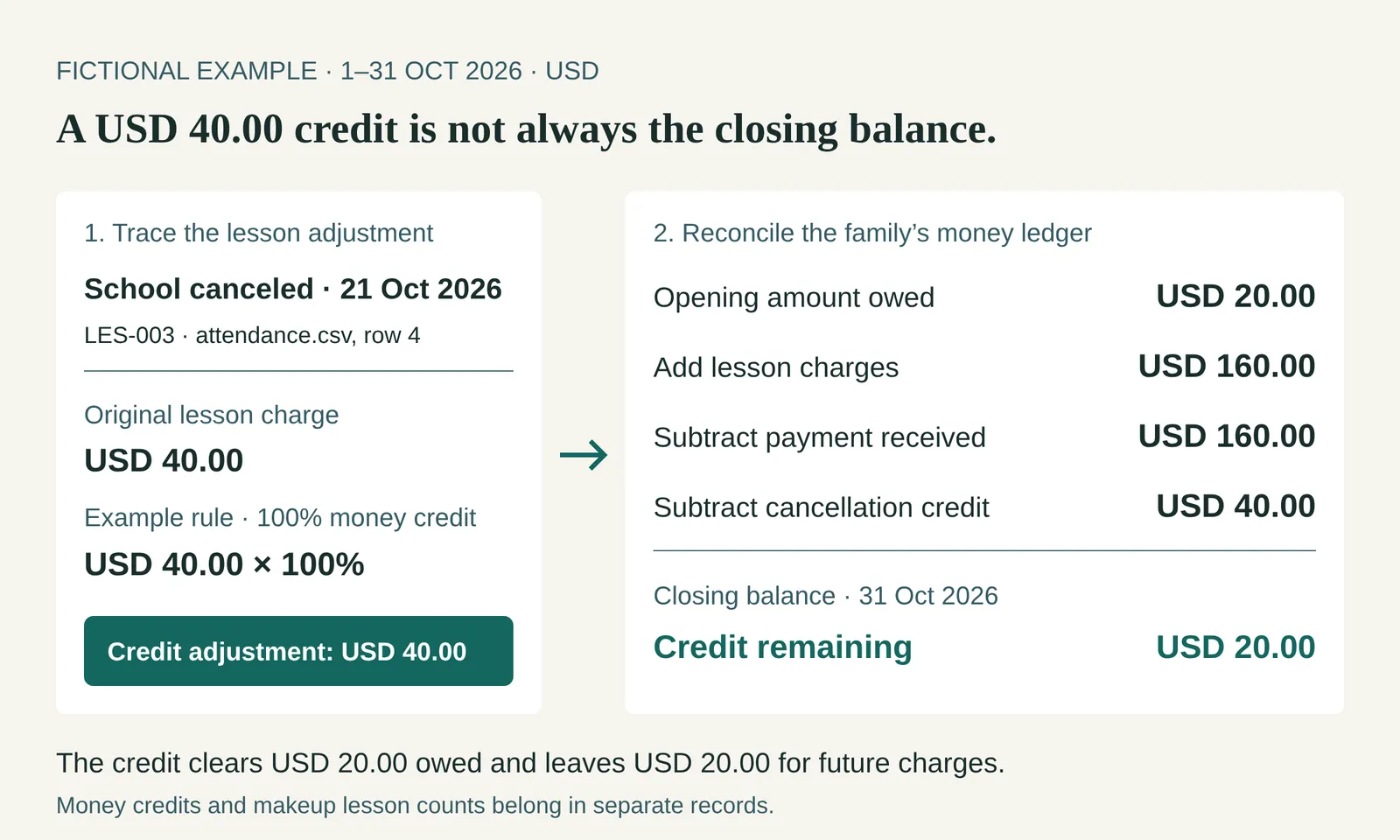
To calculate music lesson cancellation credits, first check whether your school’s policy grants a money credit, a makeup lesson, or neither. If it grants a money credit, apply the approved percentage to the original billed lesson amount, then reconcile that adjustment with the family’s opening balance, charges and payments. Only reverse a charge already included in the ledger: leaving a canceled lesson uncharged and also crediting it gives the family the benefit twice.
Check what the cancellation policy actually grants
“Canceled” describes the event. It doesn’t tell you the financial outcome.
For each canceled lesson, record who canceled, the lesson date, when notice arrived if your rule depends on it, and the policy that applied. Then classify the outcome:
| Policy outcome | Money record | Makeup record |
|---|---|---|
| Full money credit for a billed lesson | Reverse the full eligible charge | No makeup unless separately granted |
| Partial money credit | Reverse the approved portion of the charge | Follow the separate makeup rule |
| Makeup only | Keep the original charge | Add one eligible makeup entitlement |
| No credit or makeup | Keep the charge if your policy requires it | No new entitlement |
These are possible outcomes, not recommended terms for every school. For example, Bellinghome School of Music’s published policy says makeup credits cannot be applied to invoices and sets separate conditions for teacher-cancellation money credits. It also distinguishes bonus lessons in a flat-rate month from billed lessons.
If your monthly tuition covers an annual program rather than individually priced lessons, don’t divide a payment by that month’s scheduled lesson count without checking your agreement. Use the credit value your policy defines. If the policy is unclear, resolve that decision before calculating the balance.
Calculate music lesson cancellation credits from the original charge
For a billed lesson eligible for a percentage-based money credit:
Cancellation credit = original eligible lesson charge × approved credit percentage.
A USD 40.00 lesson with a 100% credit produces a USD 40.00 adjustment. The same charge with an approved 50% credit produces USD 20.00. Don’t use a teacher’s new rate to reverse an older charge at a different rate.
Keep these details beside the adjustment:
- Family ID and lesson ID.
- Lesson date and original charge, with currency.
- Cancellation reason and notice timestamp when needed.
- Source record, such as an attendance spreadsheet row.
- Applied rule or approved exception.
- Money credit amount and any separate makeup entitlement.
For the worked example below, the record is lesson LES-003 on 21 Oct 2026, a school-initiated cancellation with an original USD 40.00 charge. The example rule grants a full money credit, and no makeup is recorded. The adjustment therefore reduces the amount owed by USD 40.00.
Reconcile the credit with the whole family balance
A USD 40.00 adjustment doesn’t necessarily leave USD 40.00 available for future tuition. The family may already owe money.
Here is a fictional family ledger for 1–31 Oct 2026. Four lessons at USD 40.00 were billed, including the lesson later canceled. The family paid USD 160.00 and entered the month owing USD 20.00.
| Movement | Effect on amount owed | Amount |
|---|---|---|
| Opening balance | Amount already owed | USD 20.00 |
| Four billed lesson charges | Add | USD 160.00 |
| Payment received | Subtract | USD 160.00 |
| Full credit for LES-003 | Subtract | USD 40.00 |
| Closing balance, 31 Oct 2026 | Credit remaining | USD 20.00 |
Using positive totals for amounts owed, the signed calculation is opening amount owed USD 20.00 + lesson charges USD 160.00 − payments USD 160.00 − cancellation money credit USD 40.00 = −USD 20.00. A negative total means USD 20.00 credit remaining. Equivalently, USD 200.00 in payments and credits exceeds USD 180.00 owed before them by USD 20.00.
For a spreadsheet using positive numbers for amounts owed, use:
Closing balance = opening balance + charges − payments − money credits
Enter an opening credit as a negative value in that calculation. In the family-facing result, translate the sign into a label: “Amount owed: USD 20.00” or “Credit remaining: USD 20.00.” Don’t leave families to interpret a minus sign.
Fictional example · USD
Try one cancellation
This uses the standard full-credit rule: school and teacher cancellations need no notice; family cancellations need recorded notice meeting the threshold. Change the lesson, opening-balance, payment, and rule inputs. Changes stay in this tab until you deliberately create a separate public share link or choose the separate practice handoff. Calculation input values never go in the page address.
Why: The school canceled the lesson. This selected rule grants eligible school-initiated cancellations a full tuition credit; the canceled lesson remains among the 4 scheduled lesson charges. A notice threshold does not apply.
Traceable fictional ledger · 2026-10-01–2026-10-31
Amount owed before payments and credits: opening amount owed USD 20.00 + lesson charges USD 160.00 = USD 180.00.
Payments and credits available: opening credit remaining USD 0.00 + payments USD 160.00 + cancellation money credit USD 40.00 = USD 200.00.
Credit remaining: USD 200.00 payments and credits − USD 180.00 owed before payments and credits = USD 20.00 credit remaining.
Opening credit and cancellation credit are separate ledger entries; a makeup lesson is not money.
Illustrative calculation only—not approval of school records, a policy recommendation, or a family statement.
Browser-only downloads; entries are not sent anywhere. These illustrative files are separate from the fixed sample downloads and are not approved family statements.
Don’t credit a lesson that you already left uncharged
You can reach the same result by excluding the eligible canceled lesson from the charges in the first place. In this example, three chargeable lessons total USD 120.00:
Using positive totals for amounts owed, the signed calculation is opening amount owed USD 20.00 + lesson charges USD 120.00 − payment USD 160.00 = −USD 20.00. A negative total means USD 20.00 credit remaining. Equivalently, USD 160.00 in payments exceeds USD 140.00 owed before payment by USD 20.00.
That method needs no additional USD 40.00 cancellation adjustment. If you reduce the charges to USD 120.00 and subtract another USD 40.00 credit, you incorrectly show USD 60.00 credit remaining.
Choose one method and keep it consistent. When correcting an existing billed ledger, retain the original charge and add a linked reversal so you can explain the change. When calculating charges from attendance before billing, document the canceled lesson’s no-charge outcome instead of adding a second benefit.
Review these records before sending a statement
Before approving a family balance, check:
- Family matching: a payment belongs to the correct family ID, especially when a payer’s name differs from the student’s.
- Period boundaries: the opening balance hasn’t already included a payment or credit you’re adding again.
- Duplicate adjustments: the same lesson ID hasn’t received the same reversal twice.
- Missing policy evidence: any required notice timestamp or exception approval is recorded.
- Makeup treatment: a makeup for an already-paid lesson isn’t charged again unless your agreement explicitly requires it.
Keep an unresolved record in review rather than substituting a guessed amount. A correct total without a traceable reason is difficult to explain the next time a family asks about it.
Explain the adjustment and the remaining balance separately
A statement note for this example could read:
Our records show that the school canceled lesson LES-003 on 21 Oct 2026. Under the school’s full-credit cancellation rule, we applied a USD 40.00 tuition credit. After your opening amount owed of USD 20.00, October charges of USD 160.00 and payment of USD 160.00, your balance on 31 Oct 2026 is USD 20.00 credit remaining for future tuition charges.
A tuition credit in the school’s records is not a cash refund. If you approve a refund, record it separately so the same money isn’t both returned and left available against future tuition.
You can follow this fictional balance in Tufton’s public sample, selecting a movement to see its source and the applied cancellation rule.
To try the full reconciliation flow, create or sign in to your school workspace. Today you can upload fictional or fully anonymized CSV/XLSX spreadsheets, map and confirm the inputs, review adjustments, approve an issue-free reconciliation, and download a balance CSV and family PDF statements. Compare the results with your own approved calculations. Real personal-data uploads remain unavailable pending approved privacy and commercial terms.